Taking the Listening Test
50 minutes
About the Listening sub-test
The Listening sub-test consists of three parts, and a total of 42 question items. The topics are of generic healthcare interest and accessible to candidates across all professions. The total length of the Listening audio is about 40 minutes, including recorded speech and pauses to allow you time to write your answers. You will hear each recording once and are expected to write your answers while listening.
The Listening sub-test structure
Part A – consultation extracts (about 5 minutes each)
Part A assesses your ability to identify specific information during a consultation. You will listen to two recorded health professional-patient consultations and you will complete the health professional’s notes using the information you hear. Note: the health professionals may be any one of the 12 professions who can take OET.
Part B – short workplace extracts (about 1 minute each)
Part B assesses your ability to identify the detail, gist, opinion or purpose of short extracts from the healthcare workplace. You will listen to six recorded extracts (e.g. team briefings, handovers, or health professional-patient dialogues) and you will answer one multiple-choice question for each extract.
Part C – presentation extracts (about 5 minutes each)
Part C assesses your ability to follow a recorded presentation or interview on a range of accessible healthcare topics. You will listen to two different extracts and you will answer six multiple-choice questions for each extract.
How is listening ability assessed in OET?
The Listening sub-test is designed to assess a range of listening skills, such as identifying specific information, detail, gist, opinion or the speaker’s purpose. These skills are assessed through note-completion tasks and multiple-choice questions.
Assessors who mark the Listening sub-test are qualified and highly trained. Candidate responses are assessed against an established marking guide. During the marking session, problematic or unforeseen answers are referred to a sub-group of senior assessors for guidance and all papers are double-marked to ensure fairness and consistency.
How is the listening test scored?
Your answers for Part A are double-marked by trained OET assessors.
These answers are randomly assigned to assessors to avoid any conflict of interest.
Your answers for Part B and Part C are computer scanned and automatically scored.
For Part A, Listening assessors use a detailed marking guide which sets out which answers receive marks. Assessors use this guide to decide whether you have provided enough correct information to be given the mark. Assessors are monitored for accuracy and consistency.
How does the Listening Part A task work?
Part A of the Listening sub-test consists of a recorded consultation between a health professional and a patient. You will be given an answer booklet for this task with various headings above a space where you can write notes. As you listen to the dialogue between patient and professional, you must record notes beneath the headings. Your notes should relate to the headings and be only the most important information you hear.
Although you will hear the conversation only once, there will be pauses during the recordings allowing you time to write your notes. It’s important to know that longer pauses in the recording likely mean the end of each numbered question. This is a good time for you to go back and make sure you have written notes under each of the headings in the question. The information you’ll need for your notes will be provided to you in order, so make sure you follow along instead of jumping to ahead or back while you are listening. In this part of the test you can use either pen or pencil. Overall this task will last about 20 minutes.
Example of the OET Listening Part A task
Below is a sample of the format for the headings and note taking space you will be completing. Keep in mind that you must only write what you think is the most important and specific information in your notes, not just the general ideas.

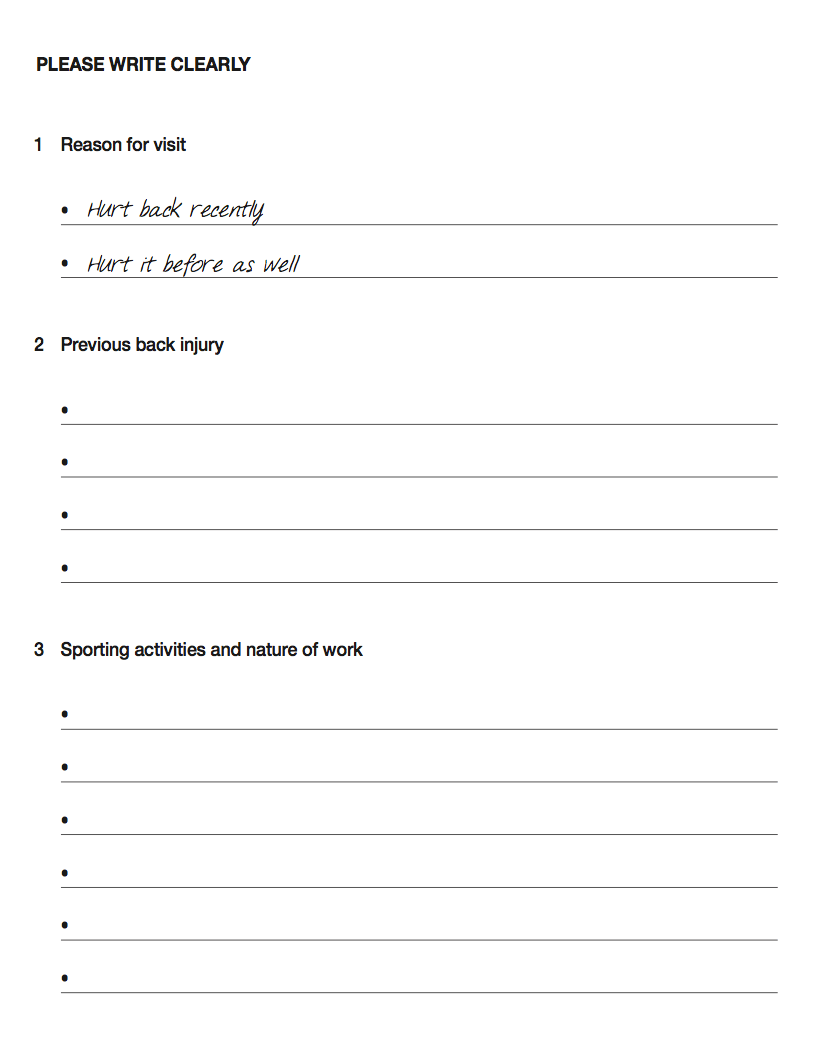
This practice content was obtained from the official Cambridge OET website. For more free, downloadable practice content, visit: https://www.occupationalenglishtest.org
How does the OET Listening Part B task work?
In Part B of the listening sub-test, you will listen to a recording of a talk or lecture about a health-related issue. You will be given an answer booklet and while you listen to the monologue you must fill in the answers to a number of questions presented in several formats (i.e. note taking, true/false, sentence completion, multiple choice etc.). In total this task will take about 30 minutes.
Before the recording begins, you will have some time to skim all of the questions to get an idea of the format. You will hear the monologue only once, and it is important to remember not to jump backwards or ahead because the questions will be in order. You can use a pen or a pencil to fill in your answers. If you make a mistake in your response, you don’t have to worry about erasing it; simply cross it out and write your new answer. This will save you time.
Example of the Listening Part B task
Below is a sample of the question format you will encounter in Part B. In this case, you would be listening to a lecture about cardiac investigations and must fill in the correct answers to each question as you listen. Remember, each question may be formatted differently, so it’s important to look over your answer booklet before you begin the task so that you know what to expect.


This practice content was obtained from the official Cambridge OET website. For more free, downloadable practice content, visit: https://www.occupationalenglishtest.org
OET Listening
Q: How is this section structured?
A. This section is broken into two parts, each containing one task.
Part A is a recording of a simulated professional-patient consultation (about 15 minutes) with note-taking questions. You must create case notes (under the correct heading), and write down all of the relevant information that you hear about the patient in the recording. You’ll have 25 minutes in total for this task.
Part B consists of a lecture or talk on a health related topic that will last about 15 minutes. You must answer a series of short answer/ note-taking questions based on what you hear in the recording. You will have 25 minutes in total for this task.
Q. What skills are being tested in this section?
A. Part A is aimed at assessing your ability to pinpoint and organize critical information in a healthcare setting. This means that you recognize which aspects of the recording are relevant to your patient’s health, and you understand where to put this information.
Part B is assessing whether or not you understand specific information presented to you in English. You must be able to listen for the information that fits each question appropriately and ignore any extra information presented to you.
Q. How many times will I have to do each task?
A. You only have to complete each task only once.
 OET- WINNER ONLINE OET