OET Training With Expert – Contact +91 6238 553 560
We always Maintain 85 % pass rate in Writing, which is better than any largest institute in the world
“I am writing to transfer Mr. Shannon Warne, who is suspected to have permanent neurological damage. He requires rehabilitation care at your facility to regain his lost skills. Mr Warne admitted to the hospital with a broken neck and a fractured pelvis following a car accident. He was treated conservatively, also started speech therapy, hydrotherapy, and physiotherapy. However, he has difficulty in mobility, speech and memory due to neurological damage. Therefore, he requires ongoing high-level care at your facility. Apart from this, his condition has significantly improved. His bedsores healing well since he start mobilizing with wheelchair.
Mr Warne is an architectural student at Adelaide University. His parents are willing to take him home after discharge. His interested activities are hockey, fishing, and photography.
Considering his condition, encourage him to engage with with people of his age group and interested activities to reduce his depression. Also, he needs your assistance to make arrangements for continuing his education externally.
Please do not hesitate to contact me for further queries.”
I am writing to refer to baby Dylan and his mother Sylvia. Dylan is dehydrated and has constipation due to improper feeding methods. Therefore, his mother Elizabeth requires education regarding proper proper Feeding method
Sylvia breastfed Dylan for the first three weeks and started formula feeds as per her mother-in-law’s advice when she was sick. Silvia does not have adequate breast milk therefore Mother in law added extra powder in formula feeds, which resulted in dehydration. Dylan is uncomfortable with bottle feeding and he was unsettled in summer heat wave.
Dylan is born with a birth weight of 4.2. He is slightly lethargic and passes dark urine. Dylan has only 3 wet nappies in the past hours
” Join WINNER ONLINE OET for OET/ IELTS Training. OET Group Booking for 21500 INR
Contact Number +91 6238 553 560
In view of the above condition, advice Sylvia to increase the frequency of breastfeeding. please instruct Sylvia about the proper preparation of boiled and cooled water. Also, remember Sylvia to keep the baby in a cool place to prevent dehydration. Please schedule a follow up review after 48 hours to monitor baby’s progress.
Please update us regarding baby’s condition. Yours sincerely
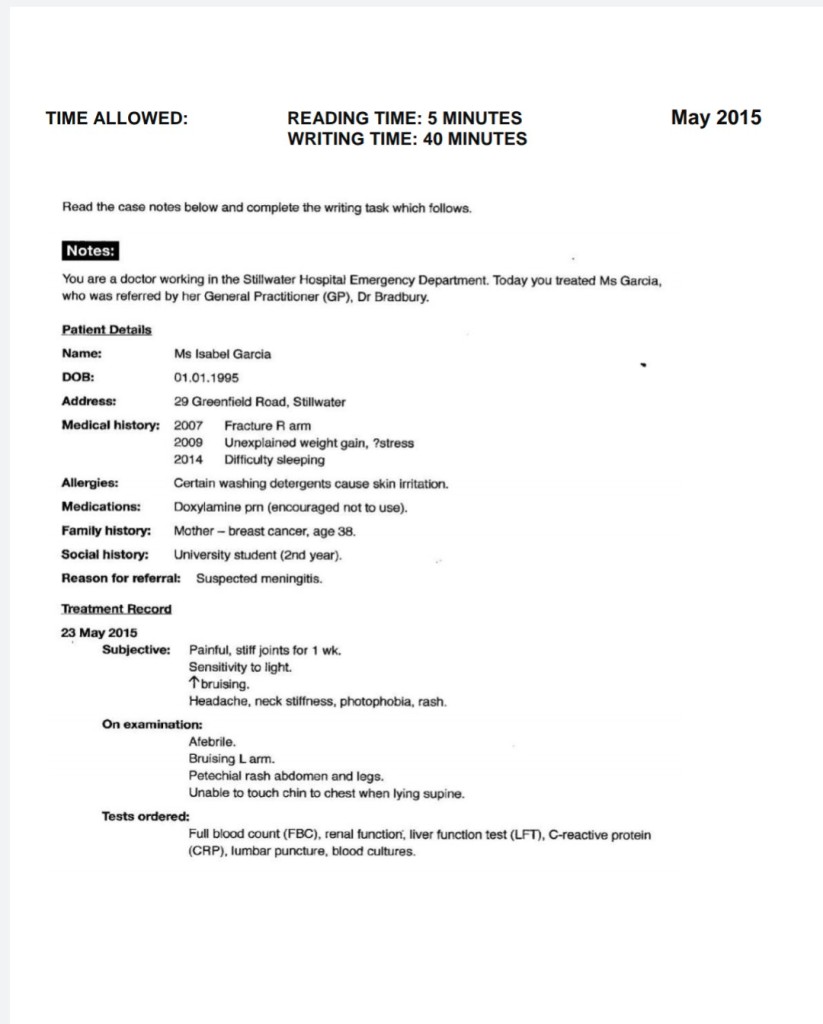
Dr. Lorna Bradbury. Stillwater Medical Clinic 12 Main Street Stillwater 23rd May 2015 Dear Dr. Bradbury, Re: Ms. Isabel Garcia DOB: 1/1/1995 I am writing to update you regarding Ms. Garcia, a 20-year-old student who has been treated successfully for bacterial meningitis. Your further follow up would be highly appreciated. Ms. Garcia was referred with suspected meningitis for urgent management. At that time, she was presented with painful stiff joints, headache, neck stiffness, photo-phobia and rash. On examination, she was afebrile and was unable to touch her chin to chest while lying supine. In addition, petechial rashes over abdomen and legs along with a bruise on her left arm was found. Therefore, suspecting meningitis, required blood tests with lumber puncture were ordered. After receiving blood test results where white cell count and CRP were significantly raised, empirical antibiotic ceftriaxone with dexamethasone were started with a proper dosage schedule. Moreover, benzylpenicillin was added when bacterial meningitis was confirmed through lumbar puncture and culture results. the patient was responded to the treatment, discussion regarding immunization was had with her family. Furthermore, the services was notified. In view of the above, the patient needs your further follow-up and it would be highly appreciated if you could arrange chemoprophylaxis for people in recent close contact along with advice for
seeking urgent medical attention if there any signs of unusual illness. Yours sincerely, Doctor
Winner Online OET for OET Medicine / Nurses Training. +916238553560
Dr. L Roberts Admitting Officer Newtown Hospital 1 Main Street Newtown
10/02/2014
Dear Dr. Roberts Re: Mrs May Hong
I am writing to refer this patient, a 43 year-old lady who has symptoms and signs of right lower lobar pneumonia for admission and further management.
Mrs. Hong has rheumatic carditis since childhood associated with mitral regurgitation and atrial fibrillation. She is a light smoker and currently is on digoxin 0.125 mg AM and warfarin 4 mg PM.
Initially, on 07/02/2014 she presented to me complaining of productive cough for the last 3 days and associated with fever. On examination, she appeared tired, febrile with a temperature of 38.0 °C, pulse was 80 beat per minutes with atrial fibrillation, BP was 140/80 mmHg. She had moist cough, scarttered ronchi through the chest and apical pansystolic murmur on consultation. Therefore, Amoxicillin 500 mg orally t.d.s was prescribed based on my provisional diagnosis, and she was advised to stop smoking.
Two days later, unfortunately her condition continued to deteriorate, with increased productive cough with yellow phlegm. On examine, she looked exhausted, with a temperature of 38.5 °C, pulse 92 beats per minute with atrial fibrillation, and BP 120/80. On chest consultation, there was a mild crakles at right lung base posteriorly and occasional scattered crackles. Therefore, blood tests, sputum sample for culture and sensitivity, and a chest x-ray were requisted.
Regrettably, on 10/02/2014, her symptoms had worsened. She had right lower lobe dull to percusion. her blood tests results revealed gram-positive no streptococcus pneumonia which sensetive to clarithromycin.
In view of the above, I believe she needs urgent admission and further management. I appreciate your attention to her
Thank you for seeing Ms. maria Joseph, whose features are suggestive possible intracranial pathology or space-occupying lesions. She needs an urgent assessment and management at your service for her speedy recovery
Today she fell at home due to severe left-sided headaches. Her right is injured and has bruises on the left leg. Also, she is semiconscious with slurred speech. Further, examination revealed elevated vitals signs and leg muscle strength of 4/5
Initially, Ms. Maria presented to our hospital on 10/05/2011 with signs and symptoms of excess tension such as headache, nausea, and vomiting. Therefore, advised to take adequate rest and administered analgesics. On 14/05/2011, she reported worsening symptoms and 5 times vomiting within the last 3 hours. In addition, she had a slight Paresthesia. Elevated vital signs and normal peripheral nervous system were noted on further observation. Hence stat pethidine 100mg and Maxolon 10 mg were administered as her symptoms indicate the possibility of severe migraine.
In view of the above condition, an immediate evaluation is highly beneficial to overcome her present condition. all relevant documents attached to this letter.
If you have any quires regarding her condition, please do not hesitate to contact me
Many OET Test takers ask questions about the word limit for the OET Writing test:
• Which words are counted? • Which words are not counted? • Do words with hyphens count as one or two words? • What happens if I write more than the word limit? • What happens if I write less than the word limit? And so on…
The purpose of the word limit in OET Writing sub test
Essentially, the word limit of 180-200 words is there as a guide. If there was no word limit given at all, then some candidates would write far too little for the assessors to be able to grade their language level. On the other hand, some candidates would write far too much without showing any restraint for the task.The guide of 180-200 words is set because the case notes have been written in such a way for it to be possible for a candidate to write a satisfactory letter using them within the time limit of 40 minutes.
OET Training with winner Online OET . Please Contact winner Online OET
The body of the letter is the part that is included within the word limit. This means the paragraphs of your letter: everything after your lines which start ‘Dear’ and ‘Re” and before your closing sentence e.g. ‘If you have any questions…’
…and which words aren’t included
The address, date, greeting (Dear..), References … are not counted at the top of your letter. The closing sentence, ending and job title are not counted at the end of the letter. Words which are hyphenated would count as one word.
You should not count your words during the writing test. The guide of 180-200 words is not set to be strictly adhered to. You have better things to be doing with your time such as proofreading your answer for grammar and content mistakes. The assessors will not count your words. They also have better things to be doing with their time. Instead they will read your letter to check you have included all of the relevant information the reader of the letter needs and have omitted any irrelevant information.
An estimate is good enough
A good way of estimating how many words you have written and which is appropriate for the test is to know how many words you average on one line. You can do this now, as part of your preparation. Look at an average line of text that you have written, perhaps for a practice task and count how many words you have written. Divide 180-200 words by this number and you now know the rough number of lines you need to write. This knowledge is enough. If you write this number of lines in the test, you can feel confident that your answer is within the word limit without counting your words.
The problems with writing too much or too little
There are problems associated with writing too much or too little. If you write much less than the guide of 180-200 words, not only will you not have given the assessors enough language to grade your proficiency, but it’s also likely that you will not have included all the relevant details the reader needs to understand the situation.
If you write too much, it’s likely that you will have included unnecessary details which make your reader work harder to understand what is important in the situation. To write so many words, it’s also likely that you may have had to write fast which is going to increase the chance of you making mistakes. Either way, writing too much or too little can have a negative effect on your overall score.
Seriously, don’t count your words In OET writing!
Remember, the word limit is a guide. If you have a rough idea of how much you need to write but focus on including the relevant information in an order that is clear to the reader as your priority, you are going to be more successful in the writing test.
Thank you for seeing Mrs Olsen. She has persistent chest pain with elevated blood pressure. It would be highly appreciated if you could conduct an immediate assessment and treatment. Today she refused her dinner because she felt slightly nauseous. She had trouble sleeping and complained of shoulder and neck pain. Her condition has further deteriorated within a few hours. Therefore she was commenced on normison and two Panadol tablets at 10 pm. Further observation at 10.45 pm, Mrs Olsen appeared distressed, pale and sweaty along with persistent chest pain. Her blood pressure was 190/100 mmHg. please note, a week before she complained about indigestion which was treated with Mylanta
She was diagnosed with hypothyroidism in 1997, hypertension in 2003 and glaucoma in 2004. Mrs Olsen is currently on prescription medication which includes: karvea 150 mg daily, oroxin 0.1 mg daily, timoptol eye drops 0.5% twice a day and normison 10 mg as required. She also takes non-prescription medication which includes: golden glow glucosamine tablet one daily and vitamin C complex sustained release with breakfast. Please also note, she has an allergy to penicillin.
In view of the above condition, I am referring Mrs Olsen for immediate assessment. Should you have further queries, please don’t hesitate to contact me
No.1 in OET TRAINING. @ Affordable Fees and Best results Contact +91 6238 553 560 What’s App – +44 7710 173736
The first thing you should read on test day – as soon as you open up your OET exam booklet – is the OET Writing TASK. It’s located at the bottom of the case notes. So just skip the case notes to focus on the TASK.
You can think of the TASK as your essay question. You wouldn’t just write an essay without firstly reading the essay question, right? Well, it’s the same for OET writing. Before you know what to write you need to read the TASK because the TASK will tell you all the critical things you need to know.
The TASK will tell you WHO you are writing to, or, in short, the recipient’s profession. Knowing that you are writing to a dermatologist, or a dentist or a dietician will determine which case notes you are going to select. Think about it… what a dermatologist would want to know would differ enormously compared to what a dentist would need to know.
The TASK will tell you WHETHER THE RECIPIENT KNOWS THE PATIENT OR NOT. Be careful, this can be subtle. But it’s a very important piece of information to know. Think about it… if you’re writing to a patient’s GP (apostrophe GP) then that GP obviously knows the patient. If the TASK says nothing about the relationship you can assume that the patient and the professional don’t know each other. Whether or not the patient knows the professional will change how ‘relevant’ the case notes are. For example, if the patient knows the GP; if it’s his or her GP then selecting case notes from ‘medical history’ will not be so relevant… right?
The TASK will usually tell you what to REQUEST from the recipient. While this information will also be found in the management or discharge plan, there will usually be a phrase or two outlining the REASON for writing the letter in the first place, such as “for further testing and a second opinion”.
You can see how critical the TASK is. It’s a very small chunk of writing, but if you get it wrong it could steer your letter in the wrong direction. Winner online Oet has a range of TASKS in its case notes so you can practice all the different types. No surprises on test day! Our course also provides you with a great OET writing overview.
Case Note Structure 1: Main Medical Issue
Now that you’ve read the TASK, you’re ready to read the OET nursing case notes or OET medical case notes, or whichever OET profession you are. They are, of course, different for each medical profession.
The case notes will generally follow two types of structures – at least that’s what I have seen.
The first way that the OET case notes might be structures is by ‘MAIN MEDICAL ISSUE’. That is, there will be one main issue, a secondary issue and some other unrelated issues. Your job will be to locate the main medical issue – usually found under ‘admission diagnosis’ or a similar subheading. You will then need to identify the surrounding secondary issue or issues.
For instance, you might have a patient who has earache. This is the admission diagnosis; this is the main medical issue. Let’s say you’re writing to an ENT specialist. In addition to the earache, this person has seeing ‘flashes’ and having mild headaches. These would be the related secondary issues that should follow in your letter. As an aside, the patient may have changed medications recently, so that should be mentioned as well, but it should certainly not be mentioned at the top of the letter as ‘PRIORITIZATION’ is key. Make no mistake: Put the most important information at the top of the letter.
Case Note Structure 2: Chronological Order
The second OET case note structure that you might see is when the patient visits your clinic or hospital several times over a period of time. Let’s call this structure ‘chronological’.
Even though there is a time element added to this structure of case notes, there will also be a ‘main presenting issue’, and this should be prioritised, just as above. But the added challenge here is that you also outline the events that took place.
Remember that this is a pretty basic OET writing overview.

OET Training With Expert – Contact +91 6238 553 560




 OET- WINNER ONLINE OET