PASSIVE VOICE: WHEN TO USE IT AND WHEN TO AVOID IT

Written by Tim Corson and Rebecca Smollett, University College Writing Centr. University of Toronto

What is passive voice?

In English, all sentences are in either “active” or “passive” voice:

active: Werner Heisenberg formulated the uncertainty principle in 1927.

passive: The uncertainty principle was formulated by Werner Heisenberg in 1927.

In an active sentence, the person or thing responsible for the action in the sentence comes first. In a passive sentence, the person or thing acted on comes first, and the actor is added at the end, introduced with the preposition “by.” The passive form of the verb is signaled by a form of “to be”: in the sentence above, “was formulated” is in passive voice while “formulated” is in active.

In a passive sentence, we often omit the actor completely:

The uncertainty principle was formulated in 1927.

When do I use passive voice?

In some sentences, passive voice can be perfectly acceptable. You might use it in the following cases:

  1. The actor is unknown:The cave paintings of Lascaux were made in the Upper Old Stone Age. [We don’t know who made them.]
  2. The actor is irrelevant:An experimental solar power plant will be built in the Australian desert. [We are not interested in who is building it.]
  3. You want to be vague about who is responsible:Mistakes were made. [Common in bureaucratic writing!]
  4. You are talking about a general truth:Rules are made to be broken. [By whomever, whenever.]
  5. You want to emphasize the person or thing acted on. For example, it may be your main topic:Insulin was first discovered in 1921 by researchers at the University of Toronto. It is still the only treatment available for diabetes.
  6. You are writing in a scientific genre that traditionally relies on passive voice. Passive voice is often preferred in lab reports and scientific research papers, most notably in the Materials and Methods section:The sodium hydroxide was dissolved in water. This solution was then titrated with hydrochloric acid.In these sentences you can count on your reader to know that you are the one who did the dissolving and the titrating. The passive voice places the emphasis on your experiment rather than on you.Note: Over the past several years, there has been a movement within many science disciplines away from passive voice. Scientists often now prefer active voice in most parts of their published reports, even occasionally using the subject “we” in the Materials and Methods section. Check with your instructor or TA whether you can use the first person “I” or “we” in your lab reports to help avoid the passive.To learn more about the use of passive voice in the sciences, visit our site for OET Training / IELTS TRAINING

When should I avoid passive voice?

Passive sentences can get you into trouble in academic writing because they can be vague about who is responsible for the action:

Both Othello and Iago desire Desdemona. She is courted. [Who courts Desdemona? Othello? Iago? Both of them?]

Academic writing often focuses on differences between the ideas of different researchers, or between your own ideas and those of the researchers you are discussing. Too many passive sentences can create confusion:

Research has been done to discredit this theory. [Who did the research? You? Your professor? Another author?]

Some students use passive sentences to hide holes in their research:

The telephone was invented in the nineteenth century. [I couldn’t find out who invented the telephone!]

Finally, passive sentences often sound wordy and indirect. They can make the reader work unnecessarily hard. And since they are usually longer than active sentences, passive sentences take up precious room in your paper:

Since the car was being driven by Michael at the time of the accident, the damages should be paid for by him.

Weeding out passive sentences

If you now use a lot of passive sentences, you may not be able to catch all of the problematic cases in your first draft. But you can still go back through your essay hunting specifically for passive sentences. At first, you may want to ask for help from a writing instructor. The grammar checker in your word processor can help spot passive sentences, though grammar checkers should always be used with extreme caution since they can easily mislead you. To spot passive sentences, look for a form of the verb to be in your sentence, with the actor either missing or introduced after the verb using the word “by”:

Poland was invaded in 1939, thus initiating the Second World War.

Genetic information is encoded by DNA.

The possibility of cold fusion has been examined for many years.

Try turning each passive sentence you find into an active one. Start your new sentence with the actor. Sometimes you may find that need to do some extra research or thinking to figure out who the actor should be! You will likely find that your new sentence is stronger, shorter, and more precise:

Germany invaded Poland in 1939, thus initiating the Second World War.

DNA encodes genetic information.

Physicists have examined the possibility of cold fusion for many years.

I’m new to OET. What’s the best way for me to prepare?

What is the best way to prepare for OET?

1. Start early.

Of course it depends on your current level of English but even candidates whose language level is test ready still need to take time to prepare properly. OET is a high-stakes English test. This means that your results are used by organisations who require the highest levels of security and validity from them. After all, successful candidates will be responsible for the health and safety of patients.

Perhaps it’s helpful to think of it like your driving test. Do you remember the feeling of learning to drive? Somewhere between excitement and fear? You wouldn’t have considered booking your driving test until you felt confident that you could perform all the required manoeuvres, start and stop the car safely and drive in a variety of weather conditions.

OET is the same. You need to give yourself time to prepare for the different parts of the test. Even though you will find the context of the test familiar, you shouldn’t assume you can apply for the test and ace it the first time around if you haven’t taken the time to prepare. To return to the car analogy, imagine you are taking a second driving test in a car with the controls on the other side to those you are used to. The country where you are taking the second test drives on the other side of the road. Although you are a good driver in your own country, you would still want to take time to prepare and familiarise yourself with how the car operates from the other side and the road rules of the second country. It makes sense.

2. Be realistic with yourself.This relates to the previous point. We know OET is life-changing. Achieving successful OET grades has the potential to take you and your family to a new country changing the way you live and work. We want to help you get there as soon as possible BUT you need to be realistic about how long this will take.

Take one of the sample tests available on our website and mark your answers for Listening and Reading using the answer key. If you have access to an English teacher or a friend with native-standard English, ask for feedback on your Writing and Speaking.

Stop.

What were the results? How close are they to where they need to be?

3. Know your weaknesses

Don’t just focus on how many questions you got right or what you did well in Speaking and Writing. It’s good to know your strengths but it’s much more important to know your weaknesses.

As you look again at your wrong answers or mistakes, ask yourself these questions:

  • Why did I make this mistake? Was it from not reading the question carefully, rushing, lack of knowledge about grammar, vocabulary etc.
  • How can I avoid making this mistake next time? The answer to this question is likely to relate to your answer to the previous question.

4. Understand the assessment criteria

As well as understanding why you made mistakes, you also need to be clear with what the assessor is expecting you to demonstrate in the test.

For each part of the test there is information about assessment. For Writing and Speaking particularly there are level descriptors of each criterion which help you understand the way OET assessors grade you.

Writing

Speaking

Listening

Reading

5. Improve your skills

Now you have a clear understanding of your strengths and weaknesses, spend time working to improve them.

This doesn’t mean taking practice test after practice test. All this will do is make you very familiar with the test format. You won’t come across the same topics and questions on test day so rather than focusing on the format, focus on your language skills.

Watch the OET Masterclasses. Even if you’ve already watched them once, watch them again. With your new knowledge of what you need to improve, you will have a clearer understanding about how to apply the strategies they include.

Join a Facebook Live Q+A session. These are held twice a month and are an opportunity for you to ask an OET expert your preparation questions.

Enrol in a Preparation Course. It’s not easy studying alone. Our Premium Preparation course providers offer courses which will make a significant difference to your language level and give you a better chance of success on test day. If there isn’t one local to you, choose one of the providers offering online courses.

Self-study. Use the materials available to you on the OET website and @OfficialOET Facebook page. We update these regularly with tips, language articles, blog posts etc. Also consider purchasing preparation material from the shop including practice test books, coursebooks etc.

6. Apply when you are ready.

Don’t rush into applying until you feel confident you have the language skills you need for the grade you want. I know you are planning your new life already but you’ll get there a lot quicker if you go cautiously now. With the right preparation, you can take the test and get the results you want without the need for resits or repeated study. It will pay off in the long run.

HAVE HAD And HAD HAD In OET

OET Training At 44 USD or 3000 Indian Rupees . Contact +916238553560 or

what’s app +916238553560 support@winneronlineoet.com

Are you confused about how to use HAVE HAD and HAD HAD in English? Today’s lesson will help you! First, we need to understand the present perfect tense and past perfect tense. Both of these tenses are formed by using an auxiliary verb + main verb:

PRESENT PERFECT
= HAVE / HAS + MAIN VERB (PAST PARTICIPLE)

Examples:

  1. have finished all my homework.
  2. She has gone to the store.
  3. We have lived here for three years.

The present perfect is used when an action starts in the past and continues to the present (example #3) or when talking about past actions WITHOUT saying when they happened (examples #1 and #2).

PAST PERFECT
= HAD + MAIN VERB (PAST PARTICIPLE)

Examples:

  • My husband had finished all the housework by the time I got home from work.
  • When I called Laura last night, her husband told me she had gone out.
  • had lived in 5 different cities before I turned 10 years old.

The past perfect is used when one past action happens before another past action/event.

WHEN TO USE HAVE HAD & HAD HAD

In the present perfect, the auxiliary verb is always have (for I, you, we, they) or has (for he, she, it).

In the past perfect, the auxiliary verb is always had.

We use have had in the present perfect when the main verb is also “have”:

  • I’m not feeling well. I have had a headache all day.
  • She has had three children in the past five years.
  • We have had some problems with our computer systems recently.
  • He has had two surgeries on his back.

We use had had in the past perfect when the main verb is also “have”:

  • Last weekend I just wanted to relax because I had had a busy week.
  • The director told me he had had a meeting with the president.
  • We had had some trouble with our washing machine, so we called a repairman.
  • She woke up screaming because she had had a bad dream.

Important: In spoken English, we almost always use the “short form”:

It’s also common to have another word in the middle:

  • We’ve recently had some problems with our computer systems.
  • He’s just had two surgeries on his back
  • The director said he’d already had a meeting with the president.
  • By the time I was 30 I’d only had one serious boyfriend.

Use the correct tense to write about ‘today’s visit’

OET ONLINE COURSES AT WINNER ONLINE OET ,,,www.winneronlineoet.com

CONTACT phone / what’s app+916238 553 560

Email-support@winneronlineonlineoet.com

One of the most common questions we are asked is which tense to use to report events from ‘today’s visit’ with the patient. Similar to when writing about relationship statuses, it is important to use the right tense.

When discussing ‘today’s visit’, you are reporting on a completed past event. However, you may not necessarily report all details from the visit using the past tense.

While this may sound confusing there are some tips you can follow to help. Here are some that can help you decide which tense is the right one:

  1. Past tense

For details such as test results or vital signs, which were accurate at the time of the visit, the past tense is appropriate.

Example:

  • On examination, the abdomen was tender on palpation.
  1. Present tense

For details such as lifestyle choices, the present tense is appropriate

Example:

  • Despite previous advice, Mr Hoskings is still smoking 20 cigarettes a day.
  1. Present perfect

For details which describe unresolved situations such as improvement or deterioration in the patient’s condition, the present perfect tense is appropriate.

Example:

  • Since her last visit, Mrs Baxter’s pain levels have reduced from an 8 to a 4.

It is fine to use more than one tense within the paragraph describing the visit. But always make sure you use the correct tense for the meaning you intend so as not to confuse the reader.

If you would like to find more helpful writing tips like this, take a look at our OET Preparation . You’ll find tips about all aspects of the English language.

OET Writing Tips – How to get an A on the OET writing sub-test

OET ONLINE COURSES AT WINNER ONLINE OET ,,,www.winneronlineoet.com

CONTACT phone / what’s app+916238 553 560

Email-support@winneronlineonlineoet.com

In this OET Writing article, we will share how you can get a high score on this sub-test. The OET Writing sub-test is unlike any other writing test.

Make sure you fill out the form below to receive a list of simplified medical vocabulary you can use on the OET!

In the IELTS and the PTE, you have to write an ‘essay’. You are given a prompt and you write according to your thoughts. In the OET, you do not write according to your thoughts. In fact, there is very little room for creativity at all.

In the OET Writing, you have case notes and a task. You need to select from the case notes according to the task, create a logical structure for your letter and then make sure that the letter is written in your own words.

Whether you’re a nurse, doctor, dentist or physiotherapist, this blog post will show you how to write the OET sub-test to get an A (or a B)!

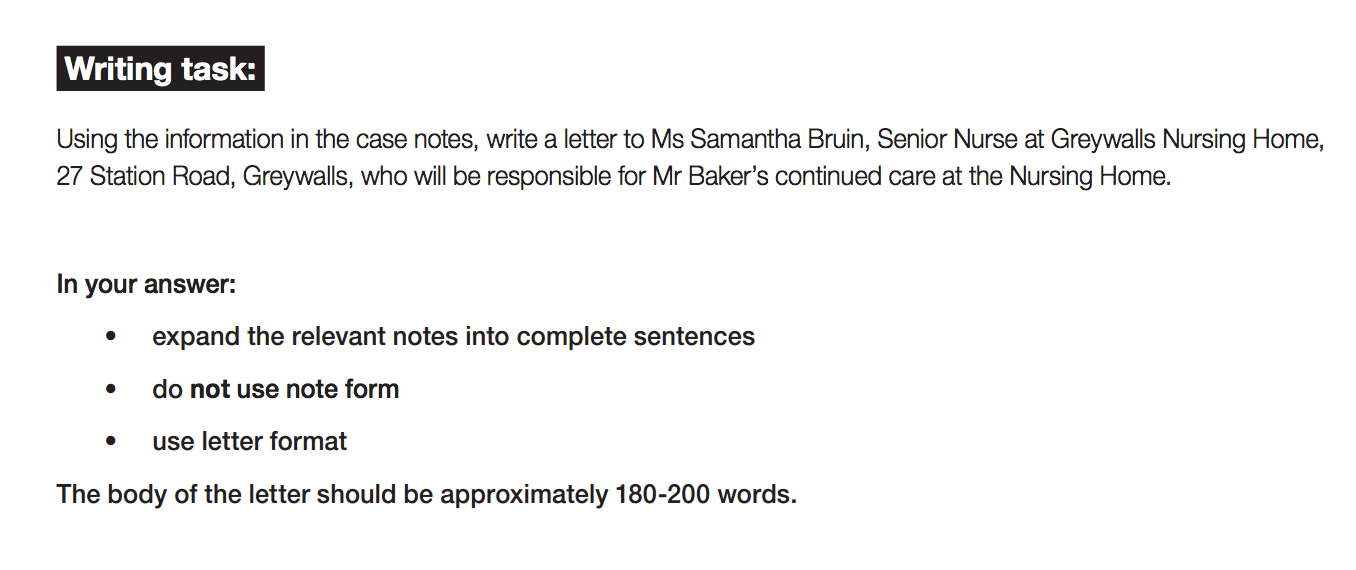
The Task

OET Writing Tips - Writing Sample
Material from http://www.occupationalenglishtest.org

The task is the most important part of the case notes. It should be the first thing that you look at in the 5 minutes reading time. The Task tells you WHO you are writing to and WHY. By understanding the Task (who and why) you will then be able to select case notes that are relevant to the reader

Does the reader already know the patient or are you introducing the patient to the reader?

Compare these two tasks:

Task 1:

Using the information in the notes, write a letter back to the referring GP, Dr Jones, detailing your findings and suggested a treatment plan.

Task 2:

Using the information in the notes, write a letter to Dr Jones detailing your findings and suggested a treatment plan.

In task 1 the doctor already knows the patient. In task 2 the doctor does not know the patient.

How do you think your selection of case notes will change if the doctor knows or does not know the patient?

The answer to this is that they will change significantly. For instance, if the doctor already knows the patient, do you need to include much information from the medical history? No. But if the doctor has never met the patient before? Yes!

Whether read knows or does not know the patient will influence which case notes you choose and why.

Who are you writing to?

Consider these two tasks:

Task 1:

Using the information in the notes, write a letter of referral to Dr Jane Smith at Cicil Dermatology Clinic.

Task 2:

Using the information in the notes, write a letter of referral to Dr Jane Smith at Cicil Neurology Clinic.

The person you are writing to – or what their job is – will almost completely change the way you write your letter. For example, which person would want to know about acne – the dermatologist or the neurologist? Who would want to know about visual perception issues – the dermatologist or the neurologist?

New call-to-action

Take-home message

The OET examiners purposefully put in case notes to distract you from the Task. Make sure that you understand the task – who you are writing to and why. If you understand the Task your chances of completing the task successfully will increase dramatically.

Read the sample writing sub-test letters to see how they are constructed according to the Task.

The E2-OET Writing Tips and Method

Male doctor taking notes

E2Language.com has created a powerful method to help you to write your OET letter successfully. The method works for nurses, doctors, dentists – all professions.

The method is simple and has three steps:

Let’s look at each of these steps in more depth.

OET Writing Tips 1 – Selecting case notes

We’ve already talked about the importance of understanding the Task in order to select relevant case notes. That is a big part of it.

After you have understood the Task you then need to be able to look at the case notes and understand WHICH ONES ARE IMPORTANT, and WHICH ONES ARE UNIMPORTANT.

The OET examiners purposefully put in UNIMPORTANT case notes to distract you. Be sure not to include these case notes. For example, if you are writing to a doctor about a patient’s diabetes don’t include that they broke their wrist twelve years ago. It’s completely irrelevant.

OET Writing Tips 2 – Organising case notes

You need to organise your case notes into neat paragraphs. This is a very common mistake made by OET candidates. They just mix all of their case notes into what looks like a paragraph, put a space under it and start another mixed paragraph. I can’t emphasise enough how important it is to have a CLEAR STRUCTURE.

The way you structure your OET writing should be according to:

  1. Introductory sentence
  2. The main issue
  3. The secondary issue
  1. Any other details
  2. The request

The issue will most likely be medical but it might be social. The secondary issue might be medical or social. Any other details may include medication or something else of relevance that did not fit into 1. and 2. Finally, your letter should end with the request to the medical professional or whomever you’re writing to, and this often takes into account the discharge plan or management plan.

Let’s look at this structure in more detail:

The introductory sentence

In the case notes there will be one particular medical issue that will stick out. It is usually found in the ‘admission diagnosis’ section of the case notes. For example, it may be “recurring headaches”. And in the Task, Discharge Plan or Management Plan you may be asked to refer the patient to a neurologist for assessment.

Therefore you need to include two pieces of information in your introductory sentence. (Let’s say that the neurologist knows this patient.)

I am referring Tim back into your care for full assessment of his recurring headaches.

You can see here that there are two pieces of information:

  1. The request
  2. The main medical issue – the headaches

In a single sentence, we have summarised what is happening is what we want the reader to do. This is a great way to start your letters.

The main medical issue

Following on from the introductory sentence we then need to specify in more detail the main medical issue – in this case, the recurring headaches. So we should scan the case notes for ANY information relating to Tim’s headaches. We can then write this up into a single paragraph that encapsulates all the relevant information that the neurologist needs.

The secondary issue

You will notice when you are scanning the case notes that there will be a secondary issue emerging. This will be less important than the main medical issue but it will warrant its own paragraph. For example, following on from our example of headaches, let’s say that Tim is also getting dizzy. There will be several (3-4 case notes) explaining something about Tim’s dizziness. We then outline this secondary issue in the second paragraph.

It’s important to understand that we want to keep our paragraphs single-themed. That is, paragraph one should be about headaches and headaches ONLY. It should not include any other information. The second paragraph – though related to headaches – should only include information related to dizziness.

MIXING IDEAS IN YOUR PARAGRAPHS WILL RESULT IN A LOW GRADE

https://www.facebook.com/groups/2263575390583146/

Any other details

There may be a few odds and ends in the case notes that are worth mentioning to the neurologist. For example, let’s say that Tim has been on a new diet, been drinking more and doing less exercise. Are these directly related to headaches or dizziness? No! Therefore, we do not include them in Paragraph 1 or 2. Instead, we can create a third paragraph for related information that the neurologist may want to know.

The request

We have mentioned the Request in the introductory sentence but we should make it more explicit in the final paragraph. Here we should loudly say to the neurologist (or whomever) what it is that we want them to do. Remember, this information will be in the Task, Discharge plan or Management plan.

For example,

I am referring Tim back to your for assessment of his recurring headaches.

It may sound repetitive but it’s okay. You need to say the request twice: once at the beginning of the letter and once at the end of the letter.

OET Writing Tips 3 –

Transforming case notesThe final step after you have selected and organised the case notes is to TRANSFORM the case notes for you MUST NOT copy the case notes directly into your letter. Of course, some allowance is given for transferring and some case notes you simply cannot change but most of the case notes are short and ungrammatical. Your job is to tell a story to the reader. You are taking the case notes and re-working them so that they make sense and fulfil the task.Check out speaking tips.

OET Writing Tips

Here’s a summary of some important OET Writing Tips to remember:

Tip #1 Make sure that you understand the task – who you are writing to and why. If you understand the task your chances of completing the task successfully will increase dramatically.

Tip #2 Read the sample writing sub-test letters to see how they are constructed according to the Task.

Tip #3 Look at the case notes and understand which ones are important, and which ones are unimportant.

Tip #4 Organise your case notes into neat paragraphs with a clear structure: introductory, main and secondary issues, any other details and the request.

Tip #5 Select and organise your case notes by transforming the case notes. You MUST NOT copy the case notes directly into your letter, rather tell a story to the reader to fulfil the task.

You need a good approach to writing these types of letters. Without a good approach, the case notes can be overwhelming. There is often a lot of information and for physiotherapists, dentists and doctors, there is often more than there is for nurses…

Remember, you need to be able to:

  1. Select,
  1. Organise, and
  2. Transform the case notes into a letter of between 180-200 words.
  3. It’s no easy task, but it is possible with practice, feedback and guidance.Start your OET course today!

New call-to-action

Study better with this tip from the OET Experts

Each time you start a study session for OET, do you start on a fresh topic? Perhaps for your next study session, try something a little different.

Use your memory better

Instead of starting with something new, spend 5-10 minutes remembering what you studied in the previous session. The benefit of this is that you are starting the process to embed the content into your long-term memory.

Apparently, humans need to read something 5 times before they will retain the information. If you only look at a grammar point once, then you are unlikely to be able to apply this learning the next time you need to use it.

Start with a quick recall

One way to start your session is with a blank piece of paper or blank document on a screen. Simply note down what you can recall from the last session. It could be facts you studied about part of the test or a strategy you learnt to improve your performance.

You can then move into studying something different. Each day, this simple act of remembering should make each study session have more impact on your overall improvement and progress towards the test.

For more study tips, make sure you check out the winner online oet . It’s filled with a whole heap of tips and tricks you can put into use before your test.

Are you having problems with pronouns?

Mrs Miles presented with her daughter who is concerned she may have dementia.

Can you identify the problem in this sentence?

There are two women in the sentence: Mrs Miles and ‘her daughter’. Using the female pronoun, ‘she’ is therefore confusing. Is the daughter concerned she has dementia or her mother has dementia?

It’s important to pay close attention to this when using pronouns to make sure they don’t end up causing confusion to the reader. They are a grammar device to avoid repetition and add clarity but, in the example, above create the opposite effect.

Do you know how to correct this sentence?For more tips like these, make sure you take a look at the winneronlineoehttps://winneronlineoet.com . You’ll find heaps of informative articles that will help you get the score you need.

Answer: Mrs Miles presented with her daughter who is concerned her mother may have dementia.

OET EXAM TIPS

Where to write the date and which date to use are two very frequently asked questions in the OET


Should it come at the very top of the letter or after the address? Should it be in full-form or numbers separated by slashes? Is it the date of the test, the discharge date of the patient or some other date?

If this is something that is worrying you, then the tips below are going to be very reassuring:

• The position of the date can be either above the address or below the address. It is normal to leave a blank line space between the date and address

Date (this position is acceptable)

Name of person
Address
Address

Date (this position is acceptable)

• In formal letters, it is normal for the date at the start to be written in full form e.g. 2nd October 2018 rather than 2/10/18. [Numbers and slashes is fine within the body of the letter] • The test materials are specifically written for the test date each month so the date to use is also the same date as the test. The test date will also be the date of discharge, most recent consultation etc. within the case notes.
• If you make a mistake in the test and write a different date or use numbers not words, DO NOT PANIC, this cannot fail you. The assessors are looking for your understanding of letter writing convention in English. It is much more important that a date is on the letter than that the date you used is correct.

Design a site like this with WordPress.com
Get started